Within Sky Trumpets
Why Weather Can Make Sounds Seem Overhead
Temperature inversions can bend and carry sound so a faraway industrial or transport noise seems to come from above.
On this page
- How temperature layers trap and redirect sound
- Why low frequency noise is hard to place outdoors
- Weather clues to check after a sky trumpet report
Page outline Jump by section
Introduction
Many “sky trumpet” reports describe a sound that seems to come from directly overhead even though no object is visible. One of the strongest non-UFO explanations is a weather-driven acoustic effect: temperature inversions and related atmospheric ducting. Under the right conditions, the atmosphere bends sound waves back towards the ground, allowing distant industrial machinery, trains, aircraft, construction activity or other low-frequency sources to travel far beyond their usual range. The result can be a loud, eerie noise that appears detached from its true origin. Acoustic research and meteorological observations show that these conditions can both amplify distant sounds and distort a listener’s sense of direction, especially for deep tones that humans already struggle to locate accurately. NOAA[Acoustics Today]acousticstoday.orgTurbulence is suppressed.Read moreAcoustics Todaysound Propagation in the Atmospheric boundary layerby DK Wilson · Cited by 44 — Low wind, clear, nighttime: Ground-based t…

How Temperature Layers Trap and Redirect Sound
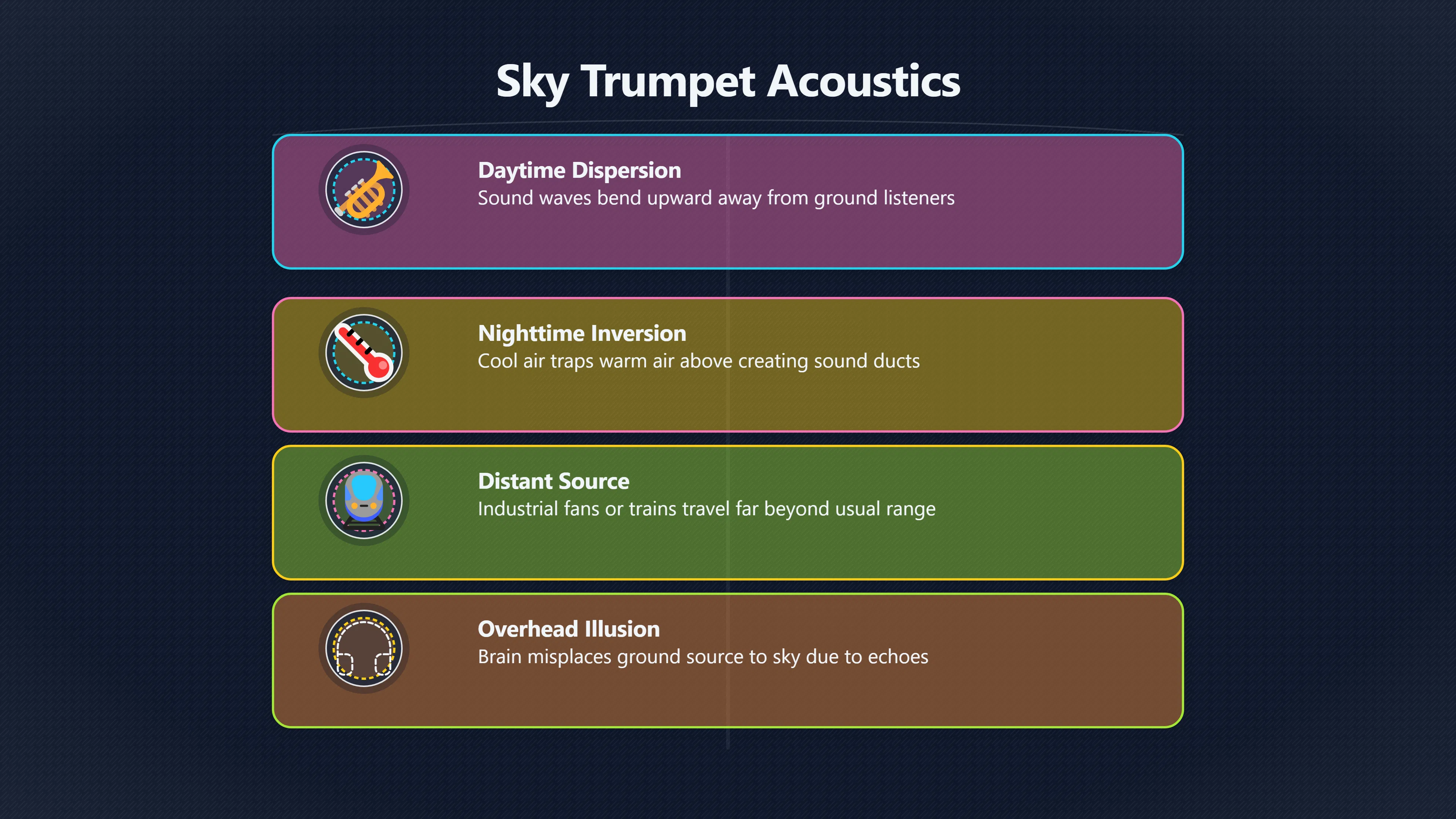
Under normal daytime conditions, air temperature usually decreases with height. In that situation, sound waves tend to bend upwards, causing some distant sounds to disperse away from listeners on the ground. At night, during calm weather, or under certain stable atmospheric conditions, the pattern can reverse. Cooler air becomes trapped near the surface while warmer air sits above it, creating a temperature inversion.[Acentech]acentech.comCold Snaps and Sound Waves: Atmospheric AcousticsFeb 15, 2022 — This condition is called a temperature inversion, where the sound…[STUDENTS]students.aip.orgphysics puzzler sound reasons the answersPhysics Puzzler: Sound Reasons: The AnswersFeb 1, 2016 — Sound travels faster in warmer air, so the sound waves are refracted upw… Because sound travels faster through warmer air, the change in temperature alters the speed of sound at different heights. The wavefront bends, or refracts, towards the cooler air below. Instead of escaping upwards, sound can curve back towards the ground. Meteorologists and acoustics researchers describe this as downward refraction, and in stronger cases it can create an atmospheric duct that channels sound over long distances.[KNMI]cdn.knmi.nlfor the assessment of low-frequency noise from…The temperature inversion corresponds to an adiabatic sound speed inversion, which prov…[3NOAA 3Dael Acoustics]acoustics.asn.auAustralian Acoustical SocietyModelling Low-Frequency Sound Propagation in a Ducted…by RC Mota · Cited by 1 — Temperature inversions an…
A useful comparison is a mirage. Just as layers of air with different temperatures can bend light and distort what people see, those same layers can bend sound and distort what people hear. The listener receives sound from an unexpected direction and distance because the atmosphere has effectively reshaped the path between source and observer.[HyperPhysics]hyperphysics.phy-astr.gsu.eduMirages and other atomospheric optic phenomenaMirages are produced by atmospheric refraction and are mainly seen in settings…
This is why residents sometimes report hearing motorway traffic, train horns, industrial fans or airport activity far more clearly than usual on certain nights. Multiple acoustics and weather references note that inversions can make distant sounds appear surprisingly loud and unusually persistent.[Encyclopedia Britannica]britannica.comEncyclopedia Britannica SoundEncyclopedia BritannicaSound - Refraction, Frequency, WavelengthApr 9, 2026 — Temperature inversion is the reason why sounds can be heard…[The Natural Navigator]naturalnavigator.comThe Natural Navigator Sounds during a temperature inversionThe Natural NavigatorSounds during a temperature inversionJanuary 7, 2019 — 7 Jan 2019 — When there is a temperature inversion it creates…[Acentech]acentech.comCold Snaps and Sound Waves: Atmospheric AcousticsFeb 15, 2022 — This condition is called a temperature inversion, where the sound…
Why a Ground Source Can Sound Like It Is in the Sky
The key misconception in many sky trumpet reports is the assumption that a sound must originate where it appears to be coming from. Human hearing does not work that way in complex outdoor environments.
People locate sound mainly by comparing tiny timing and intensity differences between the two ears. This works reasonably well for nearby sources, but accuracy declines when the sound is distant, reflected or dominated by low frequencies. In an inversion, the listener may hear a mixture of direct sound, refracted sound and echoes from terrain, buildings or cloud layers. The brain receives conflicting directional information and may place the source in the wrong location.[ETH Zurich People]people.ee.ethz.chETH Zurich People Sound propagation outdoors▷ curved propagation analogous to situation with temperature gradients upwind downwind. Page 54. Sound…Read more…[Springer Nature Link]link.springer.comSpringer Nature LinkSound Propagation in the Atmosphere | Springer Nature LinkPropagation of sound close to the ground outdoors involves…
Several factors push listeners towards an “overhead” interpretation:
- The sound lacks a visible source. If no train, factory or aircraft can be seen, people naturally look upwards.
- The sound is spread across a large area. Atmospheric ducting can make the noise seem to come from everywhere at once rather than from a single point.
- Echoes arrive from multiple directions. Reflections can blur directional cues.
- The sound persists for long periods. Sustained tones feel less like ordinary transport or industrial noise and more like an environmental phenomenon.[The Natural Navigator]naturalnavigator.comThe Natural Navigator Sounds during a temperature inversionThe Natural NavigatorSounds during a temperature inversionJanuary 7, 2019 — 7 Jan 2019 — When there is a temperature inversion it creates…[ETH Zurich People]people.ee.ethz.chETH Zurich People Sound propagation outdoors▷ curved propagation analogous to situation with temperature gradients upwind downwind. Page 54. Sound…Read more…
In some reported cases, witnesses in different locations describe the same event as coming from entirely different directions. That inconsistency is often a clue that atmospheric propagation rather than a single overhead object is involved.
Why Low-Frequency Noise Is Hard to Place Outdoors
Many sky trumpet recordings are dominated by low-frequency components: deep hums, drones, groans or horn-like sounds. Those frequencies are especially important because they travel efficiently through the atmosphere and are notoriously difficult to locate. Dael Acoustics[Australian Acoustical Society]acoustics.asn.auAustralian Acoustical SocietyModelling Low-Frequency Sound Propagation in a Ducted…by RC Mota · Cited by 1 — Temperature inversions an…
Low-frequency sound has long wavelengths. The timing differences reaching each ear become less distinct, reducing the directional information available to the brain. Outdoors, where there are few nearby surfaces to provide location cues, a listener can easily misjudge whether the source is ahead, behind, above or far off to one side.
Atmospheric ducts are particularly effective at carrying low-frequency energy over large distances. Research into outdoor acoustics and low-frequency noise repeatedly notes that inversion conditions can support unusually efficient propagation of these frequencies. Dael Acoustics[Australian Acoustical Society]acoustics.asn.auAustralian Acoustical SocietyModelling Low-Frequency Sound Propagation in a Ducted…by RC Mota · Cited by 1 — Temperature inversions an…
This helps explain why some sky trumpet videos capture a deep metallic resonance that seems disconnected from any visible activity. A distant source may have lost its higher-frequency details during propagation, leaving only the lower frequencies that survive the journey.
Why Night-Time Reports Are So Common
A striking pattern in many sky-noise accounts is that they occur during the evening, overnight or early morning.
That timing matches the periods when ground-based temperature inversions are most likely to develop. After sunset, the surface cools rapidly while the air above remains relatively warmer. Stable atmospheric layers form, turbulence decreases and sound propagation becomes more efficient. Acoustics researchers note that strong downward refraction is particularly common during calm, clear nights.[Acoustics Today]acousticstoday.orgTurbulence is suppressed.Read moreAcoustics Todaysound Propagation in the Atmospheric boundary layerby DK Wilson · Cited by 44 — Low wind, clear, nighttime: Ground-based t…[acentech]acentech.comCold Snaps and Sound Waves: Atmospheric AcousticsFeb 15, 2022 — This condition is called a temperature inversion, where the sound… People also notice unusual sounds more readily at night because background activity drops. A distant industrial hum that would be masked by daytime traffic may become obvious after dark. The inversion does not necessarily create the sound; it changes how the sound travels and how noticeable it becomes.[Acentech]acentech.comCold Snaps and Sound Waves: Atmospheric AcousticsFeb 15, 2022 — This condition is called a temperature inversion, where the sound…[Morgridge Institute for Research]morgridge.orgMorgridge Institute for ResearchHow do temperature and wind affect traffic noise?Nov 13, 2016 — In terms of temperature, sound waves move…
This overlap between inversion conditions and the timing of many sky trumpet reports is one reason atmospheric acoustics remains a leading explanation for at least some of the phenomenon.
Weather Clues to Check After a Sky Trumpet Report
When evaluating a report of mysterious sky noises, weather conditions can provide useful context.
Several clues make atmospheric sound propagation more plausible:
- Clear or mostly clear skies overnight.
- Calm winds near the ground.
- Cold air pooled in valleys or low-lying areas.
- Reports occurring around dawn or shortly after sunset.
- The presence of distant railways, airports, industrial sites, ports or major roads.
- Multiple witnesses hearing the sound but disagreeing about its direction. Wikipedia[The Natural Navigator]naturalnavigator.comThe Natural Navigator Sounds during a temperature inversionThe Natural NavigatorSounds during a temperature inversionJanuary 7, 2019 — 7 Jan 2019 — When there is a temperature inversion it creates…[Acoustics Today]acousticstoday.orgTurbulence is suppressed.Read moreAcoustics Todaysound Propagation in the Atmospheric boundary layerby DK Wilson · Cited by 44 — Low wind, clear, nighttime: Ground-based t…
None of these factors prove a specific source, but together they fit a known acoustic mechanism that has been documented in both meteorology and environmental-noise studies.
What This Explanation Can and Cannot Do
Temperature inversions do not explain every strange sky-sound report. Some recordings remain unidentified because the original source was never documented, while others may involve entirely different causes such as aircraft, industrial equipment, geological events or manipulated audio.
What inversions do explain well is a recurring pattern: a loud, low-frequency sound with no visible source, heard over a wide area, often at night, and described as coming from the sky. The atmosphere can act as a giant acoustic lens, bending and carrying sound in ways that make ordinary ground-based noises seem detached from their true origin. In the context of sky trumpet videos and UFO-related noise claims, that mechanism offers a practical reason why a sound can feel airborne even when nothing unusual is actually overhead.[Encyclopedia Britannica]britannica.comEncyclopedia Britannica SoundEncyclopedia BritannicaSound - Refraction, Frequency, WavelengthApr 9, 2026 — Temperature inversion is the reason why sounds can be heard…[3NOAA 3Dael Acoustics]acoustics.org.nzOpen source on acoustics.org.nz.
Amazon book picks
Further Reading
Books and field guides related to Why Weather Can Make Sounds Seem Overhead. Use these as the next step if you want deeper reading beyond the article.
Why People Believe Weird Things
Rating: 4.0/5 from 7 Google Books ratings
Adds context on interpreting unusual sensory experiences.
eBay marketplace picks
Marketplace Samples
Example marketplace items related to this page. Use the search link to explore similar finds on eBay.




Endnotes
1.
Source: noaa.gov
Title: The Sound of Thunder
Link:https://www.noaa.gov/jetstream/lightning/sound-of-thunder
Source snippet
The Sound of Thunder - LightningApr 5, 2023 — However, when the air temperature increases with height, called an inversion, sound wav...
2.
Source: britannica.com
Title: Encyclopedia Britannica Sound
Link:https://www.britannica.com/science/sound-physics/Refraction
Source snippet
Encyclopedia BritannicaSound - Refraction, Frequency, WavelengthApr 9, 2026 — Temperature inversion is the reason why sounds can be heard...
3.
Source: acentech.com
Link:https://www.acentech.com/resources/cold-snaps-and-sound-waves-atmospheric-acoustics/
Source snippet
Cold Snaps and Sound Waves: Atmospheric AcousticsFeb 15, 2022 — This condition is called a temperature inversion, where the sound...
4.
Source: students.aip.org
Title: physics puzzler sound reasons the answers
Link:https://students.aip.org/observer/physics-puzzler-sound-reasons-the-answers
Source snippet
Physics Puzzler: Sound Reasons: The AnswersFeb 1, 2016 — Sound travels faster in warmer air, so the sound waves are refracted upw...
5.
Source: Wikipedia
Title: Inversion (meteorology)
Link:https://en.wikipedia.org/wiki/Inversion_%28meteorology%29
Source snippet
Inversion (meteorology)In meteorology, an inversion (or temperature inversion) is a phenomenon in which a layer of warmer air overlies...
6.
Source: cdn.knmi.nl
Link:https://cdn.knmi.nl/system/data_center_publications/files/000/072/106/original/KEM31—20220711—FINAL.pdf?1706393834=
Source snippet
for the assessment of low-frequency noise from...The temperature inversion corresponds to an adiabatic sound speed inversion, which prov...
7.
Source: link.springer.com
Link:https://link.springer.com/rwe/10.1007/978-0-387-30425
Source snippet
Springer Nature LinkSound Propagation in the Atmosphere | Springer Nature LinkPropagation of sound close to the ground outdoors involves...
8.
Source: morgridge.org
Link:https://morgridge.org/blue-sky/how-do-temperature-and-wind-affect-traffic-noise/
Source snippet
Morgridge Institute for ResearchHow do temperature and wind affect traffic noise?Nov 13, 2016 — In terms of temperature, sound waves move...
9.
Source: weather.gov
Link:https://www.weather.gov/
Source snippet
National Weather ServiceUnsettled Weather in the Eastern U.S. through Memorial Day · Frost Advisory · Rip Current Statement · Beach Hazar...
10.
Source: oceanservice.noaa.gov
Link:https://oceanservice.noaa.gov/facts/sound.html
Source snippet
far does sound travel in the ocean?Jun 16, 2024 — The distance that sound travels in the ocean varies greatly, depending primarily upon w...
11.
Source: ncei.noaa.gov
Link:https://www.ncei.noaa.gov/access/metadata/landing-page/bin/iso?id=gov.noaa.ncei.pad%3ANOAA-Navy-SanctSound_Sound_Propagation_Models
Source snippet
Sound Propagation ModelsThe RL field is calculated as the difference between an assumed sound source level and transmission loss (TL), wh...
12.
Source: repository.library.noaa.gov
Title: noaa 18895 DS1
Link:https://repository.library.noaa.gov/view/noaa/18895/noaa_18895_DS1.pdf
Source snippet
Index Variance and its Height Distribution in...More recently a Doppler capability of measuring the velocity of dis tributed, clear airt...
13.
Source: Wikipedia
Title: National Oceanic and Atmospheric Administration
Link:https://en.wikipedia.org/wiki/National_Oceanic_and_Atmospheric_Administration
Source snippet
National Oceanic and Atmospheric AdministrationThe National Oceanic and Atmospheric Administration (NOAA /ˈnoʊ.ə/ NOH-ə) is a United S...
14.
Source: acousticstoday.org
Title: Turbulence is suppressed.Read more
Link:https://acousticstoday.org/wp-content/uploads/2015/06/Sound-Propagation-in-the-Atmospheric-Boundary-Layer-D.-Keith-Wilson-Chris-L.-Pettit-and-Vladimir-E.-Ostashev.pdf
Source snippet
Acoustics Todaysound Propagation in the Atmospheric boundary layerby DK Wilson · Cited by 44 — Low wind, clear, nighttime: Ground-based t...
15.
Source: acoustics.asn.au
Link:https://acoustics.asn.au/conference_proceedings/AAS2024/papers/p117.pdf
Source snippet
Australian Acoustical SocietyModelling Low-Frequency Sound Propagation in a Ducted...by RC Mota · Cited by 1 — Temperature inversions an...
16.
Source: hyperphysics.phy-astr.gsu.edu
Link:https://hyperphysics.phy-astr.gsu.edu/hbase/atmos/mirage.html
Source snippet
Mirages and other atomospheric optic phenomenaMirages are produced by atmospheric refraction and are mainly seen in settings...
17.
Source: naturalnavigator.com
Title: The Natural Navigator Sounds during a temperature inversion
Link:https://www.naturalnavigator.com/news/2019/01/sounds-during-a-temperature-inversion/
Source snippet
The Natural NavigatorSounds during a temperature inversionJanuary 7, 2019 — 7 Jan 2019 — When there is a temperature inversion it creates...
Published: January 7, 2019
18.
Source: people.ee.ethz.ch
Title: ETH Zurich People Sound propagation outdoors
Link:https://people.ee.ethz.ch/~isistaff/courses/ak1/acoustics-sound-propagation-outdoors.pdf
Source snippet
▷ curved propagation analogous to situation with temperature gradients upwind downwind. Page 54. Sound...Read more...
Additional References
19.
Source: researchgate.net
Link:https://www.researchgate.net/publication/317935869_LOCALIZATION_OF_SOUND_SOURCES_IN_TEMPERATURE_INVERSION_LAYER_DURING_A_GEOMAGNETIC_STORM
Source snippet
localization of sound sources in temperature inversion...27 Jul 2017 — Moreover, the analysis revealed a new noise producing process tha...
20.
Source: sfu.ca
Link:https://www.sfu.ca/sonic-studio-webdav/cmns/Handbook5/handbook/Sound_Propagation.html
Source snippet
Sound PropagationHigher temperatures produce higher speeds of sound. Since the temperature of the atmosphere is not uniform there are loc...
21.
Source: nsidc.org
Link:https://nsidc.org/learn/parts-cryosphere/arctic-weather-and-climate/science-arctic-weather-and-climate
Source snippet
The Science of Arctic Weather and ClimateThe air near the surface tends to be colder and more dense than air higher up, causing sound wav...
22.
Source: facebook.com
Link:https://www.facebook.com/WIS10/posts/watch-what-caused-that-loud-sonic-boom-heard-across-the-midlands-yesterday-judi-/1445305870958641/
Source snippet
WATCH: What caused that loud sonic boom heard across the...Atmospheric ducting is often suggested as a way to explain how distant explos...
23.
Source: acoustics.org.nz
Link:https://acoustics.org.nz/wp-content/uploads/Hannah_L_NZA2007_a-1.pdf
24.
Source: youtube.com
Link:https://www.youtube.com/watch?v=s7DA_KjetSw
Source snippet
Lecture 28: Meteorological Conditions and Sound PropagationLecture 28: Meteorological Conditions and Sound Propagation. 1.6K... Temper...
25.
Source: sciencedirect.com
Link:https://www.sciencedirect.com/science/article/abs/pii/S0003682X02001044
Source snippet
Simulation of a morning air temperature inversion break-up...by LR Hole · 2003 · Cited by 18 — Sound propagation in the atmosphere is in...
26.
Source: facebook.com
Link:https://www.facebook.com/groups/38680135622/posts/10172958970515623/
Source snippet
, where cooler, denser air near the ground refracts sound waves...Read more...
27.
Source: comsol.com
Title: Temperature generally decreases with an increase in altitude.Read more
Link:https://www.comsol.com/blogs/why-sounds-travel-farther-at-night
Source snippet
Why Sounds Travel Farther at NightJan 28, 2025 — The cause of this sound phenomenon is the change in temperature distribution in the atmo...
28.
Source: oro.open.ac.uk
Link:https://oro.open.ac.uk/106735/1/predictionofoutdoorgroundeffectaspublished.pdf
Source snippet
of outdoor ground effect | Open Research Onlineby K Attenborough · 2026 · Cited by 2 — The influence of atmospheric turbulence on ground...
Topic Tree