Within Sensors
The Meteor Blast Heard Around the World
The Chelyabinsk meteor showed how a sudden aerial explosion can leave a worldwide acoustic trail in scientific sensor networks.
On this page
- What the 2013 blast produced
- How global stations detected it
- Why meteor acoustics matter for UFO reports
Page outline Jump by section
Introduction
The Chelyabinsk meteor of 15 February 2013 remains one of the strongest real-world demonstrations that dramatic aerial events can leave a measurable acoustic footprint across the planet. For researchers interested in unusual sky sounds, unexplained booms or reports sometimes grouped under “UFO noises”, the event provides a rare benchmark: a known object, a known explosion and a globally recorded sound signature. Instead of relying on witness testimony alone, scientists were able to compare visual observations, seismic readings and worldwide infrasound detections from specialised monitoring stations. The result was a detailed acoustic record of an atmospheric blast powerful enough to be tracked across continents and even around the Earth.[CTBTO]ctbto.orgrussian fireball largest ever detected ctbtos infrasoundRussian Fireball Largest Ever Detected by CTBTO's…Feb 18, 2013 — Infrasonic waves from the meteor that broke up over Russia's Ura…
 The importance of Chelyabinsk is not that it explains every unusual sky-noise report. Rather, it shows what a genuinely large aerial event looks like when measured by modern sensor networks. It gives investigators a concrete reference point for separating anecdote from instrumented evidence.
The Meteor Blast Heard Around the World
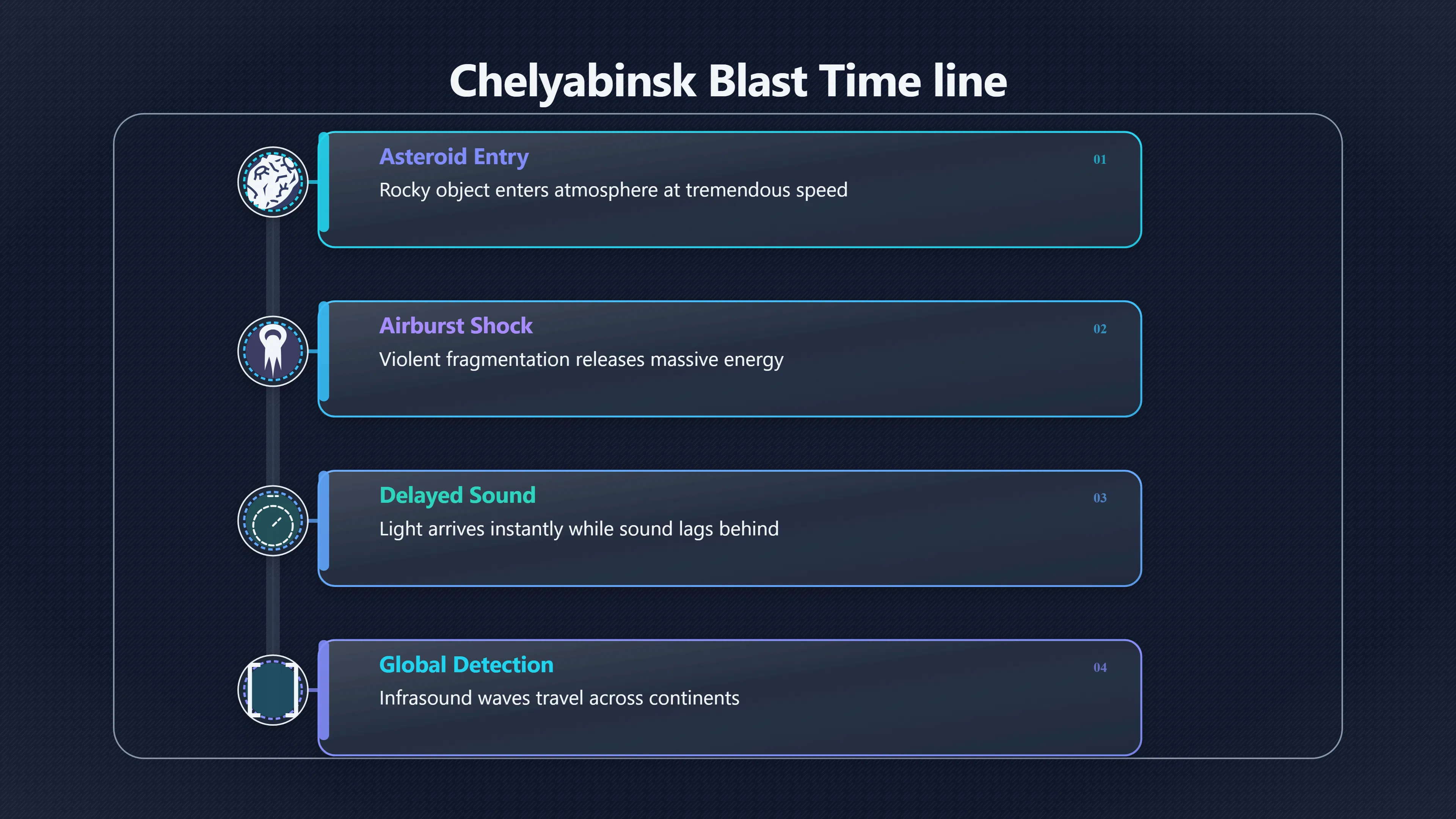
At about 03:20 UTC on 15 February 2013, a rocky asteroid roughly 18 metres across entered Earth’s atmosphere above the southern Ural region of Russia at tremendous speed. The object fragmented violently high above the ground, producing an airburst that released energy estimated at roughly 500 kilotons of TNT equivalent. The shock wave shattered windows across Chelyabinsk and injured more than a thousand people, mostly through flying glass.[ScienceDirect]sciencedirect.comCTBT infrasound network performance to detect the 2013…Read more…[NASA Science]science.nasa.govNASA ScienceTracking the Chelyabinsk Meteor PlumeShortly after dawn on February 15, 2013, a 18-meter-wide (59 foot) meteor screamed into…
What made the event scientifically extraordinary was not only the visible fireball but the acoustic aftermath. The explosion generated powerful infrasound waves — low-frequency pressure oscillations below the normal range of human hearing. Unlike ordinary sound, these frequencies can travel vast distances through the atmosphere with relatively little loss of energy.[CTBTO]ctbto.orgCTBTO Infrasound Stations Detect Russian Meteorite BlastThe low frequency sound waves from the blast were detected at 03:22 GMT by t…
Witnesses near the event described a delayed sequence of booms and pressure waves after the brilliant flash. Many videos recorded the moment when the shock front arrived, creating loud detonations and rattling buildings. The delay itself became an important clue. Light from the fireball reached observers almost instantly, while the sound arrived much later, confirming that the source was a distant atmospheric explosion rather than something occurring directly overhead.[Nature]nature.comEyes and earsFeb 19, 2013 — On 15 February, the town of Chelyabinsk in the Russian Ural Mountains had an unexpected visitor. A mete…
How Global Stations Detected the Blast
The most striking evidence came from the International Monitoring System operated by the Comprehensive Nuclear-Test-Ban Treaty Organization (CTBTO). The network was designed to detect nuclear explosions, but its infrasound stations routinely record natural events such as volcanic eruptions, ocean disturbances and large meteors.[CTBTO]ctbto.orgNothing Escapes The Global Ear: Nuclear Tests…Twenty of the CTBTO's infrasound monitoring stations detected signals made by a met…
The Chelyabinsk airburst produced the largest meteor-generated infrasound signal ever recorded by the CTBTO network at that time. Depending on the analysis and station status considered, between 17 and 20 monitoring stations detected the event. The most distant confirmed detection came from Antarctica, approximately 15,000 kilometres away from the source.[CTBTO]ctbto.orgrussian fireball largest ever detected ctbtos infrasoundRussian Fireball Largest Ever Detected by CTBTO's…Feb 18, 2013 — Infrasonic waves from the meteor that broke up over Russia's Ura…[CTBTO]ctbto.orgCTBTO Infrasound Stations Detect Russian Meteorite BlastThe low frequency sound waves from the blast were detected at 03:22 GMT by t…
Researchers were able to measure:
- Arrival times of the pressure waves.
- Signal frequencies.
- Wave amplitudes.
- Direction of travel.
- Atmospheric propagation paths.
Because multiple stations recorded the same event, scientists could reconstruct aspects of the explosion and estimate its energy independently of visual observations. This is particularly important because eyewitness estimates of brightness, distance and loudness are often unreliable during unexpected events.[AGU Publications]agupubs.onlinelibrary.wiley.com1 Introduction. The meteorite event of 15 February 2013, 03:20…
A major study examining the CTBTO response concluded that the meteor generated a globally detectable airburst and became a reference event for evaluating infrasound monitoring performance. Twenty of forty-two operational stations detected the signal, providing one of the best datasets ever collected for a natural atmospheric explosion.[AGU Publications]agupubs.onlinelibrary.wiley.com1 Introduction. The meteorite event of 15 February 2013, 03:20…
When the Shock Wave Circled the Planet
One of the most memorable findings was that the acoustic energy did not simply radiate outward and disappear. Scientists identified repeated arrivals of the infrasonic wave as it travelled around the Earth.
Some monitoring stations recorded multiple passes of the same event. Researchers found evidence that portions of the signal completed more than one circuit of the globe before fading into the atmospheric background. In some analyses, arrivals corresponding to paths totalling around 85,000 kilometres were identified.[Wikipedia]WikipediaChelyabinsk meteorChelyabinsk meteor
This behaviour matters because it demonstrates how persistent large low-frequency atmospheric disturbances can be. A witness hearing a mysterious distant rumble may assume the source is nearby, but infrasound research shows that powerful events can travel extraordinary distances under favourable atmospheric conditions.[EurekAlert!]eurekalert.orgnews releasesThe sensitivity of the CTBTO's infrasound sensors helps scientist to gauge the…Read more…
For investigators examining reports of strange sky noises, Chelyabinsk serves as a reminder that sound propagation is often counterintuitive. A noise heard in one location may originate hundreds or even thousands of kilometres away.
Why Meteor Acoustics Matter for UFO Reports
The Chelyabinsk event offers an unusually useful comparison point because the source is known. Researchers know there was a meteor, they know roughly where it exploded, and they possess independent records from cameras, satellites, seismic instruments and infrasound stations.[NASA Science]science.nasa.govNASA ScienceTracking the Chelyabinsk Meteor PlumeShortly after dawn on February 15, 2013, a 18-meter-wide (59 foot) meteor screamed into…
That combination allows several lessons to be applied when evaluating dramatic aerial-noise claims:
A genuine aerial explosion leaves multiple traces
Large atmospheric events do not usually produce only a sound. They often generate correlated evidence such as optical observations, pressure waves, seismic responses and instrument detections. The stronger the event, the more likely it is that multiple sensor systems will record it.[AGU Publications]agupubs.onlinelibrary.wiley.com1 Introduction. The meteorite event of 15 February 2013, 03:20…
Loud does not automatically mean nearby
The delayed shock wave over Chelyabinsk showed how an object exploding tens of kilometres above the ground can create intense acoustic effects over a broad region. Reports of booming sounds or pressure sensations therefore require careful distance and timing analysis before conclusions are drawn.[ScienceDirect]sciencedirect.comCTBT infrasound network performance to detect the 2013…Read more…
Infrasound provides an independent check
Many unusual aerial reports depend entirely on memory and testimony. In contrast, infrasound stations provide time-stamped physical records that can confirm whether a significant atmospheric disturbance occurred. The Chelyabinsk dataset illustrates how valuable such records can be for distinguishing real energetic events from misinterpretation or folklore.[CTBTO]ctbto.orgNothing Escapes The Global Ear: Nuclear Tests…Twenty of the CTBTO's infrasound monitoring stations detected signals made by a met…
What Chelyabinsk Changed for Acoustic Monitoring
Before 2013, meteor infrasound detection was already established, but Chelyabinsk transformed public awareness of the field. The event demonstrated that a monitoring system built for nuclear-test verification could also function as a planetary-scale detector for natural cosmic impacts.[CTBTO]ctbto.orgNothing Escapes The Global Ear: Nuclear Tests…Twenty of the CTBTO's infrasound monitoring stations detected signals made by a met…
Researchers subsequently used the Chelyabinsk data as a calibration reference for later meteor studies and for understanding how atmospheric shock waves propagate over long distances. The event also highlighted the value of combining acoustic monitoring with optical observations, satellite measurements and other sensor networks.[AGU Publications]agupubs.onlinelibrary.wiley.com1 Introduction. The meteorite event of 15 February 2013, 03:20…
Within discussions of unexplained aerial sounds, the meteor remains one of the clearest examples of acoustic proof. It shows that when a truly energetic object explodes in the atmosphere, modern instruments can capture the event far beyond the limits of human hearing. Instead of a story about mysterious noises alone, Chelyabinsk became a worldwide demonstration that the sky can leave measurable acoustic fingerprints across an entire planet. CTBTO[2earthsky.org]earthsky.orgexplosion from russian meteor heard round the world twiceto thousands of kiloton (or megaton, MT) yields.Read more…
Amazon book picks
Further Reading
Books and field guides related to The Meteor Blast Heard Around the World. Use these as the next step if you want deeper reading beyond the article.
Infrasound Monitoring for Atmospheric Studies
Directly relevant to worldwide monitoring of events like Chelyabinsk.
eBay marketplace picks
Marketplace Samples
Example marketplace items related to this page. Use the search link to explore similar finds on eBay.




Endnotes
1.
Source: ctbto.org
Title: russian fireball largest ever detected ctbtos infrasound
Link:https://www.ctbto.org/resources/for-the-media/press-releases/russian-fireball-largest-ever-detected-ctbtos-infrasound
Source snippet
Russian Fireball Largest Ever Detected by CTBTO's...Feb 18, 2013 — Infrasonic waves from the meteor that broke up over Russia's Ura...
2.
Source: sciencedirect.com
Link:https://www.sciencedirect.com/science/article/abs/pii/S0012821X14000417
Source snippet
CTBT infrasound network performance to detect the 2013...Read more...
3.
Source: science.nasa.gov
Link:https://science.nasa.gov/earth/earth-observatory/tracking-the-chelyabinsk-meteor-plume-81844/
Source snippet
NASA ScienceTracking the Chelyabinsk Meteor PlumeShortly after dawn on February 15, 2013, a 18-meter-wide (59 foot) meteor screamed into...
Published: February 15, 2013
4.
Source: ctbto.org
Link:https://www.ctbto.org/news-and-events/news/ctbto-infrasound-stations-detect-russian-meteorite-blast
Source snippet
CTBTO Infrasound Stations Detect Russian Meteorite BlastThe low frequency sound waves from the blast were detected at 03:22 GMT by t...
5.
Source: nature.com
Link:https://www.nature.com/articles/494281b
Source snippet
Eyes and earsFeb 19, 2013 — On 15 February, the town of Chelyabinsk in the Russian Ural Mountains had an unexpected visitor. A mete...
6.
Source: ctbto.org
Link:https://www.ctbto.org/resources/for-the-media/press-releases/nothing-escapes-global-ear-nuclear-tests-volcanoes
Source snippet
Nothing Escapes The Global Ear: Nuclear Tests...Twenty of the CTBTO's infrasound monitoring stations detected signals made by a met...
7.
Source: Wikipedia
Title: Chelyabinsk meteor
Link:https://en.wikipedia.org/wiki/Chelyabinsk_meteor
8.
Source: eurekalert.org
Title: news releases
Link:https://www.eurekalert.org/news-releases/914564
Source snippet
The sensitivity of the CTBTO's infrasound [sensors]({{ 'sensors/' | relative_url }}) helps scientist to gauge the...Read more...
9.
Source: earthsky.org
Title: explosion from russian meteor heard round the world twice
Link:https://earthsky.org/earth/explosion-from-russian-meteor-heard-round-the-world-twice/
Source snippet
) to thousands of kiloton (or megaton, MT) yields.Read more...
10.
Source: blogs.nature.com
Link:https://blogs.nature.com/blog/russian-meteor-blast-was-the-largest-ever-recorded/
Source snippet
meteor blast was the largest ever recorded by...Jun 10, 2013 — Fireball events in the order of 500 kilotonnes of explosive energy occur...
11.
Source: jpl.nasa.gov
Title: additional details on the large feb 15 fireball over russia
Link:https://www.jpl.nasa.gov/news/additional-details-on-the-large-feb-15-fireball-over-russia/
Source snippet
15 Fireball over RussiaFeb 15, 2013 — A meteor seen flying over Russia on Feb. 15 at 3:20: 26 UTC impacted Chelyabinsk. Preliminary infor...
12.
Source: planetary.org
Link:https://www.planetary.org/articles/20130215-what-we-know-about-the-russian-meteor
Source snippet
What We Know About the Russian Meteor Event [UPDATED]Feb 15, 2013 — Also, the estimate for energy released during the event has increased...
13.
Source: agupubs.onlinelibrary.wiley.com
Link:https://agupubs.onlinelibrary.wiley.com/doi/full/10.1002/2015GL063482
Source snippet
1 Introduction. The meteorite event of 15 February 2013, 03:20...
Published: February 2013
14.
Source: agupubs.onlinelibrary.wiley.com
Link:https://agupubs.onlinelibrary.wiley.com/doi/10.1002/grl.50619
Source snippet
AGU PublicationsThe 2013 Russian fireball largest ever detected by CTBTO...Jun 9, 2013 — [24] Infrasound signals produced by the blast o...
Additional References
15.
Source: lpi.usra.edu
Link:https://www.lpi.usra.edu/meteor/metbull.php?code=57165
Source snippet
Bulletin: Entry for ChelyabinskResidents of the Chelyabinsk district heard the sound of a large explosion. The impact wave destroyed many...
16.
Source: facebook.com
Title: ️ in 2013 a rock from space exploded over a russian city with no warning nobody
Link:https://www.facebook.com/secretsofuniverse/posts/%EF%B8%8F-in-2013-a-rock-from-space-exploded-over-a-russian-city-with-no-warning-nobody-/1465928161847447/
Source snippet
☄️ In 2013, a rock from space exploded over a Russian...On February 15, 2013, a roughly 20-meter-wide asteroid entered Earth's atmospher...
Published: February 15, 2013
17.
Source: csmonitor.com
Title: Was Chelyabinsk meteor actually a meteor Many Russians don t think so
Link:https://www.csmonitor.com/World/Europe/2013/0222/Was-Chelyabinsk-meteor-actually-a-meteor-Many-Russians-don-t-think-so
Source snippet
Was Chelyabinsk meteor actually a...22 Feb 2013 — If not a UFO, then what? For those Russians not steeped in Tungus lore, or unprepared...
18.
Source: watchers.news
Title: spectacular signals recorded from chelyabinsk meteor blast waves
Link:https://watchers.news/2013/03/05/spectacular-signals-recorded-from-chelyabinsk-meteor-blast-waves/
Source snippet
meteor's infrasound signal was was the strongest ever detected by the CTBTO network.... There is also a video where supposedly a UFO bre...
19.
Source: youtube.com
Link:https://www.youtube.com/watch?v=tbh6GjRChnQ
Source snippet
Russian Fireball Largest Ever Detected by CTBTO's Infrasound Sensors - YouTube Russian Fireball Largest Ever Detected by CTBTO's Infrasou...
20.
Source: sandia.gov
Link:https://www.sandia.gov/labnews/2013/03/08/13-08-03-3/
Source snippet
Sandia 'hears' Chelyabinsk meteor – LabNewsMar 8, 2013 — It was the largest meteor reported since one hit Tunguska, Siberia, in 1908...
21.
Source: johnrleeman.com
Title: chelyabinsk meteorite infrasound seismic and satellites oh my
Link:https://www.johnrleeman.com/2013/02/16/chelyabinsk-meteorite-infrasound-seismic-and-satellites-oh-my/
Source snippet
Chelyabinsk Meteorite – Infrasound, Seismic, and...Feb 16, 2013 — Most meteorites are never discovered as they are statistically much mo...
22.
Source: spacepolicyonline.com
Title: blast from russian meteor similar to nuclear explosion
Link:https://spacepolicyonline.com/news/blast-from-russian-meteor-similar-to-nuclear-explosion/
Source snippet
15 Feb 2013 — The atmospheric blast from the meteor that struck near the Russian city of Chelyabinsk this morning released 300 kilotons o...
23.
Source: phys.org
Link:https://phys.org/news/2013-02-russian-fireball-largest-ctbto-infrasound.html
Source snippet
Russian fireball largest ever detected by CTBTO's...Feb 19, 2013 — Infrasound is low frequency sound with a range of less than 10 Hz...
24.
Source: physicsworld.com
Title: chelyabinsk exposed the anatomy of an asteroid impact
Link:https://physicsworld.com/a/chelyabinsk-exposed-the-anatomy-of-an-asteroid-impact/
Source snippet
Chelyabinsk exposed: the anatomy of an asteroid impact6 Nov 2013 — Researchers chart the biggest airburst over our planet in more than a...
Topic Tree