Within Infrasound
Why Some UFO Hums Seem Directionless
Long low-frequency wavelengths can make a hum feel present everywhere while leaving witnesses unsure where it is coming from.
On this page
- Why low frequencies are difficult to localise
- How distance and buildings complicate source tracing
- What investigators can and cannot infer from directionless hums
Page outline Jump by section
Introduction
Reports of UFO-related hums often include a peculiar detail: witnesses can hear or feel a low vibration, yet they cannot tell where it is coming from. The sound seems to fill the environment rather than travel from a specific point. This effect is one reason ordinary mechanical or environmental noise can sometimes acquire an unusual or mysterious character. When low-frequency sound or infrasound is involved, the physical properties of the waves themselves can make localisation surprisingly difficult. Rather than hearing a clear source off to the left, right, above or behind, a listener may experience a pressure-like presence that appears to come from everywhere at once.[Wikipedia]WikipediaSound localizationSound localization
 In UFO investigations, that matters because a directionless hum can encourage people to associate the sensation with an object in the sky, an unseen craft, or an unknown force when the actual source may be distant, hidden, reflected, or entirely unrelated to what they are looking at. The difficulty of tracing low-frequency sound does not prove or disprove any UFO report, but it does explain why some acoustic experiences feel unusually elusive.
Why Low Frequencies Are Difficult to Localise
Human hearing normally determines the direction of a sound by comparing what reaches each ear. The brain looks for tiny differences in arrival time and loudness. With many everyday sounds, these cues are strong enough to identify direction almost instantly.[Wikipedia]WikipediaPerception of infrasoundPerception of infrasound[Wikipedia]WikipediaInteraural time differenceInteraural time differenceThe interaural time difference (or ITD) when concerning humans or animals, is the difference in arrival time…
Low-frequency sound behaves differently.
Long Wavelengths Reduce Directional Clues
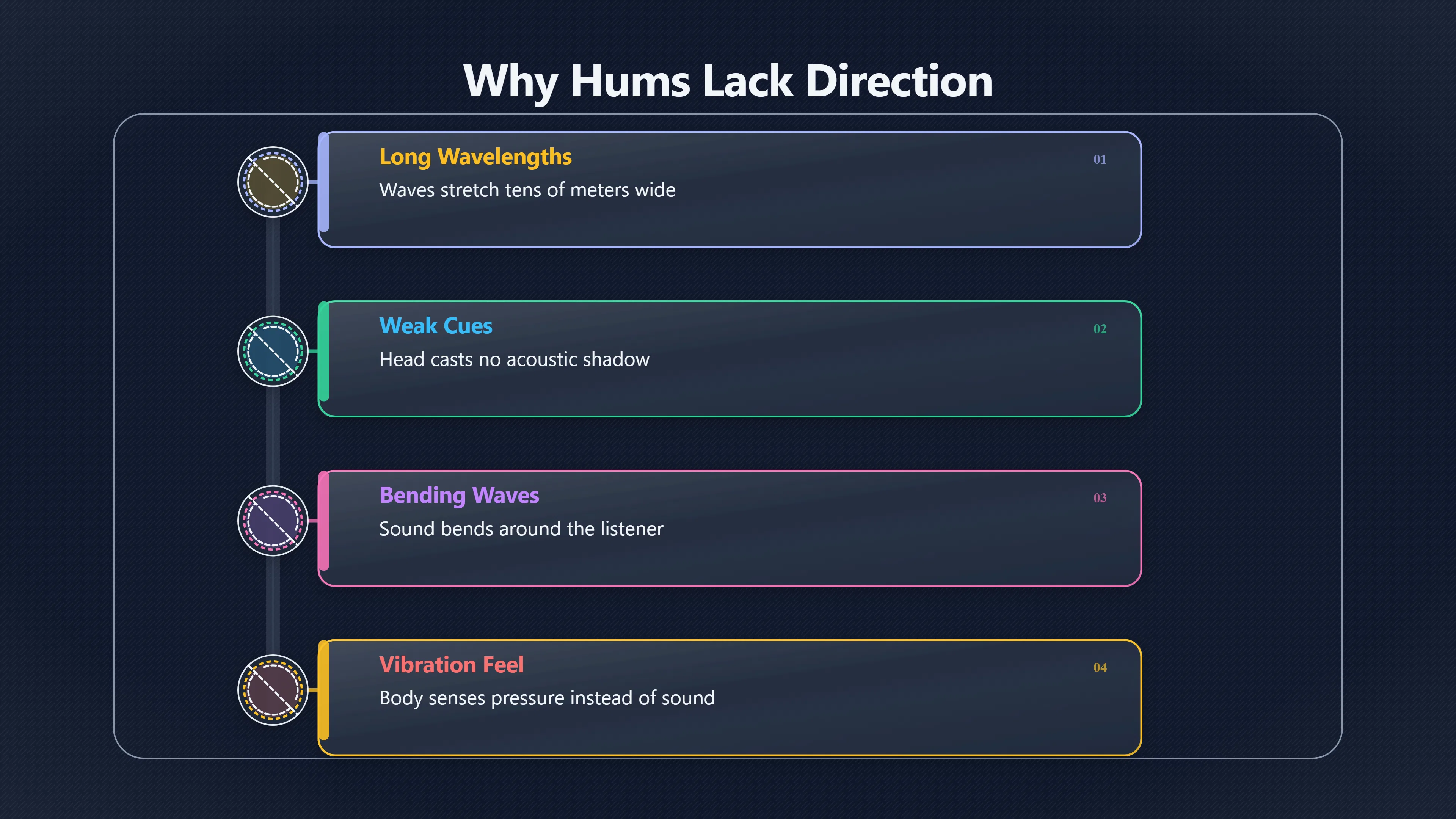
A 10-hertz infrasonic wave has a wavelength measured in tens of metres, vastly larger than the width of a human head. Because the wave is so large, it reaches both ears in a very similar way. The head does not cast much of an acoustic shadow, so the loudness difference between ears becomes extremely small.[Pressbooks]pressbooks.umn.eduPressbooks Interaural Level Difference –High frequency sounds have short wavelengths, so the head casts an acoustic…Read more…[The Science of Sound]science-of-sound.netThe Science of Sound Sound Localization BasicsAt lower frequencies, when the wavelengths of sound are in the range of the head…Read more…
Researchers studying sound localisation note that interaural level differences — one of the main directional cues used by the auditory system — become minimal at low frequencies because the sound waves simply bend around the head rather than being blocked by it.[Pressbooks]pressbooks.umn.eduPressbooks Interaural Level Difference –High frequency sounds have short wavelengths, so the head casts an acoustic…Read more…
As frequencies fall even lower, the remaining timing cues also become harder to interpret reliably. Below roughly 80 hertz, localisation accuracy can deteriorate substantially because the phase and timing information reaching each ear provides less useful directional information.[Wikipedia]WikipediaInfrasoundInfrasound, sometimes referred to as low frequency sound or (sometimes ambigously) subsonic describes sound waves with a fre…
The result is a sound that may be clearly detectable but spatially vague.
Feeling a Hum Instead of Hearing It
Another complication is that very low frequencies are often experienced partly through bodily sensation rather than ordinary hearing. People may describe pressure in the chest, vibrations in walls, a sensation in the ears, or a general environmental hum.[Wikipedia]WikipediaSound localizationSound localization
When a stimulus is perceived as a physical vibration rather than a conventional sound, the brain receives fewer spatial clues. The experience can therefore feel detached from any obvious source. Witnesses may know something is present without knowing where it is located.
This characteristic appears repeatedly in accounts of unexplained hums. The uncertainty itself can become part of the mystery. A sound that cannot be pointed toward often feels more unusual than a sound that clearly comes from a machine, road, aircraft, or building.
How Distance and Buildings Complicate Source Tracing
Even when a low-frequency source exists, tracing it can be difficult because infrasound propagates differently from higher-frequency noise.
Low Frequencies Travel Far
Low-frequency waves lose energy more slowly over distance than many higher-frequency sounds. Infrasound generated by natural events, industrial systems, atmospheric phenomena, or large machinery can sometimes travel considerable distances under favourable conditions.[CNRS News]news.cnrs.frinfrasound sound waves that nothing can stopCNRS NewsInfrasound, sound waves that nothing can stop18 Oct 2024 — Infrasound waves, very low-frequency acoustic waves below 20 hertz (H…
For someone investigating a strange hum, this creates an immediate problem. The apparent source may not be nearby. A witness looking at a light in the sky could hear or feel low-frequency energy originating from somewhere entirely different.
This does not mean every mysterious hum has a distant source, but it means proximity cannot be assumed simply because the sensation feels strong.
Buildings Can Spread the Sensation
Low-frequency waves also interact with buildings in ways that confuse localisation. Because of their long wavelengths, they can pass through structures more effectively than many higher-frequency sounds. Instead of entering a room from one obvious direction, they may excite walls, floors, windows, ductwork, or other surfaces.[Dega Akustik]pub.dega-akustik.deDega Akustik Assessing Low-Frequency and Infrasonic NoiseDega AkustikAssessing Low-Frequency and Infrasonic Noise…April 11, 2025 — by L Roskosch — Since the measured rooms do not meet the dif…
A person inside a house might therefore experience a vibration that appears to come from the entire structure.
In practical investigations of low-frequency noise complaints, residents frequently report hearing or feeling a hum throughout a building rather than identifying a precise point of origin. This does not necessarily indicate an exotic source. It often reflects the difficulty of tracing long-wavelength energy once it begins interacting with enclosed spaces.[Microflown]microflown.comLow-frequency noise can be a challenging problem to address, as it can be difficult to detect and mitigate large wavelength…Read more…
Atmospheric Conditions Can Mislead Witnesses
The atmosphere itself can alter the path of low-frequency sound. Temperature layers, wind patterns and other atmospheric conditions can refract or channel acoustic energy. Modern infrasound monitoring systems account for these effects because they can significantly change how signals propagate.[MDPI]mdpi.comThe infrasound waves are mainly divided into two categories…Read more…[2knmi.nl]knmi.nlrelaxation for sound waves, and hence these are called gravity waves.Read more…
For witnesses, this means a hum may seem disconnected from its true source location. The direction perceived on the ground may not correspond neatly to the location of whatever generated the sound.
When a UFO report includes both a visible object and a strange hum, investigators therefore have to consider the possibility that the two observations are unrelated but coincidental.
Why Directionless Hums Feel Mysterious
A sound that lacks an obvious origin can create a very different psychological impression from a normal environmental noise.
Most everyday sounds come with an immediate explanation. A passing vehicle can be tracked visually. A loudspeaker has a location. An aircraft produces a recognisable path across the sky.
Directionless low-frequency hums remove that certainty.
Witnesses often describe:
- A sensation that the environment itself is vibrating.
- A hum that appears equally strong in every direction.
- Difficulty determining whether the source is above, below, inside or outside.
- A feeling that something large is nearby despite little conventional noise.
These perceptions are consistent with known challenges in low-frequency localisation and do not require an unknown technology to occur.[PMC]pmc.ncbi.nlm.nih.govPMCAuditory localization: a comprehensive practical reviewby A Carlini · 2024 · Cited by 79 — Auditory localization is a fundamental ability that allows to perceive the spatial location of a s…
At the same time, the experience can be genuinely unsettling. Humans rely heavily on directional hearing to assess their surroundings. When the brain cannot identify where a stimulus originates, the ambiguity itself can increase attention, uncertainty and perceived significance.
What Investigators Can and Cannot Infer
A directionless hum is an interesting observation, but by itself it provides limited evidence about the source.
What It Can Suggest
If multiple witnesses independently describe a low-frequency vibration that seemed impossible to locate, investigators may reasonably consider low-frequency acoustics or infrasound among the possible explanations. The description is consistent with known properties of long-wavelength sound.[Wikipedia]WikipediaPerception of infrasoundPerception of infrasound[Wikipedia]WikipediaInteraural time differenceInteraural time differenceThe interaural time difference (or ITD) when concerning humans or animals, is the difference in arrival time…
Reports that emphasise pressure, vibration and uncertainty about direction fit what researchers know about low-frequency perception.
What It Cannot Prove
The inability to locate a sound does not demonstrate that the source was airborne, extraordinary or related to a reported UFO. Nor does it establish that infrasound was definitely present.
Many factors can produce localisation errors, including reflections, environmental noise, building resonance, hearing differences between individuals and ordinary low-frequency sources that remain unidentified.[PMC]pmc.ncbi.nlm.nih.govPMCAuditory localization: a comprehensive practical reviewby A Carlini · 2024 · Cited by 79 — Auditory localization is a fundamental ability that allows to perceive the spatial location of a s…[PMC]pmc.ncbi.nlm.nih.govPMCAuditory localization: a comprehensive practical reviewby A Carlini · 2024 · Cited by 79 — Auditory localization is a fundamental ability that allows to perceive the spatial location of a s…
For that reason, investigators treat a directionless hum as a clue rather than a conclusion. It may point toward the involvement of low-frequency sound, but additional evidence is needed before linking the sensation to any particular object or event.
The key lesson is straightforward: when a UFO hum seems to come from nowhere, the effect may reflect the physics of low-frequency sound as much as the nature of whatever the witness believes produced it. Long wavelengths, weak directional cues, environmental propagation and structural vibrations can combine to make an ordinary source feel strangely omnipresent.[Pressbooks]pressbooks.umn.eduPressbooks Interaural Level Difference –High frequency sounds have short wavelengths, so the head casts an acoustic…Read more…
Amazon book picks
Further Reading
Books and field guides related to Why Some UFO Hums Seem Directionless. Use these as the next step if you want deeper reading beyond the article.
Springer Handbook of Acoustics
Explains sound localisation, wave propagation, low-frequency acoustics and hearing.
The Soundscape
Helps readers understand how environmental sound can feel diffuse and source-less.
Infrasound Propagation in an Anisotropic Fluctuating Atmosphere
Focuses on how infrasound travels and becomes difficult to trace.
eBay marketplace picks
Marketplace Samples
Example marketplace items related to this page. Use the search link to explore similar finds on eBay.




Endnotes
1.
Source: Wikipedia
Title: Sound localization
Link:https://en.wikipedia.org/wiki/Sound_localization
2.
Source: Wikipedia
Title: Perception of infrasound
Link:https://en.wikipedia.org/wiki/Perception_of_infrasound
3.
Source: Wikipedia
Title: Interaural time difference
Link:https://en.wikipedia.org/wiki/Interaural_time_difference
Source snippet
Interaural time differenceThe interaural time difference (or ITD) when concerning humans or animals, is the difference in arrival time...
4.
Source: pmc.ncbi.nlm.nih.gov
Title: PMCAuditory localization: a comprehensive practical review
Link:https://pmc.ncbi.nlm.nih.gov/articles/PMC11267622/
Source snippet
by A Carlini · 2024 · Cited by 79 — Auditory localization is a fundamental ability that allows to perceive the spatial location of a s...
5.
Source: science-of-sound.net
Title: The Science of Sound Sound Localization Basics
Link:https://science-of-sound.net/2016/06/sound-localization-basics/
Source snippet
At lower frequencies, when the wavelengths of sound are in the range of the head...Read more...
6.
Source: pmc.ncbi.nlm.nih.gov
Link:https://pmc.ncbi.nlm.nih.gov/articles/PMC10562056/
Source snippet
Evaluation of Low-Frequency Noise, Infrasound, and Health...by SK Chiu · 2023 · Cited by 7 — Studies have shown noise-related annoyan...
7.
Source: news.cnrs.fr
Title: infrasound sound waves that nothing can stop
Link:https://news.cnrs.fr/articles/infrasound-sound-waves-that-nothing-can-stop
Source snippet
CNRS NewsInfrasound, sound waves that nothing can stop18 Oct 2024 — Infrasound waves, very low-frequency acoustic waves below 20 hertz (H...
8.
Source: mdpi.com
Link:https://www.mdpi.com/2072-4292/14/13/3181
Source snippet
The infrasound waves are mainly divided into two categories...Read more...
9.
Source: pub.dega-akustik.de
Title: Dega Akustik Assessing Low-Frequency and Infrasonic Noise
Link:https://pub.dega-akustik.de/DAS-DAGA_2025/files/upload/paper/499.pdf
Source snippet
Dega AkustikAssessing Low-Frequency and Infrasonic Noise...April 11, 2025 — by L Roskosch — Since the measured rooms do not meet the dif...
Published: April 11, 2025
10.
Source: microflown.com
Link:https://www.microflown.com/products/sound-localization-systems
Source snippet
Low-frequency noise can be a challenging problem to address, as it can be difficult to detect and mitigate large wavelength...Read more...
11.
Source: knmi.nl
Link:https://www.knmi.nl/kennis-en-datacentrum/achtergrond/infrasound-and-seismology-in-the-low-frequency-array-lofar
Source snippet
relaxation for sound waves, and hence these are called gravity waves.Read more...
12.
Source: pmc.ncbi.nlm.nih.gov
Link:https://pmc.ncbi.nlm.nih.gov/articles/PMC4271773/
Source snippet
In general, hearing-impaired listeners do less well in...
13.
Source: Wikipedia
Link:https://en.wikipedia.org/wiki/Infrasound
Source snippet
InfrasoundInfrasound, sometimes referred to as low frequency sound or (sometimes ambigously) subsonic describes sound waves with a fre...
14.
Source: pressbooks.umn.edu
Title: Pressbooks Interaural Level Difference –
Link:https://pressbooks.umn.edu/sensationandperception/chapter/interaural-level-difference-draft/
Source snippet
High frequency sounds have short wavelengths, so the head casts an acoustic...Read more...
15.
Source: quizlet.com
Link:https://quizlet.com/830126946/perception-chapter-10-flash-cards/
Source snippet
Chapter 10 FlashcardsThis type of sound localization is best for low-frequency sounds because the brain may sense slight differences in t...
16.
Source: soundand.design
Title: Auditory Localization
Link:https://soundand.design/auditory-localization-e93a6e333a4a
Source snippet
An Introduction | by Myk EffSep 1, 2024 — For lower frequency sounds, the sound waves are relatively long compared to the size of the hea...
17.
Source: production-expert.com
Title: Sound Localisation
Link:https://www.production-expert.com/production-expert-1/sound-localisation-how-does-it-work
Source snippet
How Does It Work?8 Mar 2025 — Today I'd like to walk you through the strategies of human hearing to determine from which direction a soun...
Additional References
18.
Source: audiocheck.net
Link:https://www.audiocheck.net/audiotests_basslocalization.php
Source snippet
Low Frequency (Subwoofer) Sound Localization TestOur ears are very sensitive to phase differences, more than the inter-aural delay itself...
19.
Source: researchgate.net
Link:https://www.researchgate.net/publication/272738551_Low_frequency_noise_and_infrasound_from_wind_turbines
Source snippet
Low frequency noise and infrasound from wind turbinesLow-frequency sound and infrasound measurement results at distances close to wind tu...
20.
Source: auditoryneuroscience.com
Link:https://auditoryneuroscience.com/book/export/html/54
Source snippet
Spatial HearingThis page has little animations illustrating the two major binarual cues for sound source direction: Interaural Time Diffe...
21.
Source: pmc.ncbi.nlm.nih.gov
Link:https://pmc.ncbi.nlm.nih.gov/articles/PMC3937989/
Source snippet
limits on interaural time differences - PMC - NIHby WM Hartmann · 2014 · Cited by 38 — Human listeners, and other animals too, use intera...
22.
Source: ssoar.info
Link:https://www.ssoar.info/ssoar/bitstream/handle/document/99800/ssoar-ijerph-2023-5-erdelyi_et_al-Low-Frequency_Noise_Experiences_from_a.pdf?sequence=1
Source snippet
Experiences from a Low-Frequency Noise Perceiving...by KH Erdélyi · 2023 · Cited by 7 — Abstract: Although low-frequency noise (LFN) is...
23.
Source: researchgate.net
Title: 371334455 Auditory Localisation of Low Frequency Sound Sources
Link:https://www.researchgate.net/publication/371334455_Auditory_Localisation_of_Low-Frequency_Sound_Sources
Source snippet
Auditory Localisation of Low-Frequency Sound Sources13 May 2023 — It is generally thought that humans cannot detect the direction of soun...
Published: May 2023
24.
Source: academic.oup.com
Link:https://academic.oup.com/gji/article/229/2/1152/6496032
Source snippet
low-frequency acoustic fields in urban environmentsby S McComas · 2022 · Cited by 10 — Infrasound data contain contributions from incoher...
25.
Source: youtube.com
Title: Low Official Videos · Official videos from Low’s long-spanning career. · Low
Link:https://www.youtube.com/channel/UC96CEiRB1yc0DlIDHWsPajw
Source snippet
LowOfficial Videos · Official videos from Low's long-spanning career. · Low - Disappearing (Official Video) · Low - Days Like These (Offi...
26.
Source: youtube.com
Link:https://www.youtube.com/watch?v=apwfUWVq5WM
Source snippet
Infrasound Explained: Sound Below Human Hearing Earthquakes, Elephants & More - YouTube Infrasound Explained: Sound Below Human Hearing E...
27.
Source: avsforum.com
Title: localizability of bass frequencies in rooms.3205312
Link:https://www.avsforum.com/threads/localizability-of-bass-frequencies-in-rooms.3205312/
Source snippet
Localizability of bass frequencies in roomsJun 20, 2021 — This is an attempt to summarize the current state of understanding of our abili...
Topic Tree