Within Taos Hum
Why Low Sounds Are So Hard to Trace
Low-frequency sound can travel far, feel hard to locate, and make ordinary noise sources seem stranger than they are.
On this page
- How low frequency noise behaves differently
- Why direction finding becomes unreliable
- What this means for invisible UFO noise claims
Page outline Jump by section
Introduction
One reason the Taos Hum became linked to UFO-noise theories is that low-frequency sound behaves in ways that feel deeply unnatural to human listeners. A distant engine, industrial fan, electrical installation or vibration source can seem as though it is coming from nowhere at all when most of its higher-frequency components have faded away. In the Taos reports, many people described a deep drone similar to a diesel engine or heavy machinery, yet investigators struggled to point to a single location. That combination — a sound that feels real but resists localisation — is exactly the kind of experience that encourages speculation about hidden aircraft, underground facilities or unknown technologies.[Thrillist]thrillist.comtaos hum mysteryInvestigating the Mystery of the Taos Hum29 Jun 2023 — The low buzz ranging from 30 to 80 Hz that had been reportedly heard by a…[iflscience]iflscience.comScientists found nothing, so what was it? Rachael Funnell headshot.Read more… The most important clue may not be that the sound was mysterious, but that it was low-frequency. Acousticians have long noted that low-frequency noise travels differently, interacts differently with buildings and terrain, and is much harder for people to trace accurately than ordinary environmental sounds.[Commercial Acoustics®]commercial-acoustics.comHigh frequencies are more directional and less prone to bending.Read moreCommercial Acoustics®How Sound Travels: The Science of Sound Waves!Dec 11, 2020 — Low-frequency waves diffract more easily, making them m…
How Low-Frequency Noise Behaves Differently
The frequencies often associated with the Taos Hum are at the lower end of normal human hearing, roughly in the range of a deep mechanical rumble rather than a clear tone. Reports have commonly placed the perceived sound somewhere around 30–80 Hz, although not all hearers described exactly the same pitch.[Discovery UK]discoveryuk.comDiscovery UKThe Taos Hum: New Mexico's Unexplained AcousticDecember 14, 2023 — 14 Dec 2023 — Lower frequencies below 20 Hz can sometimes be felt as vibrations rather than heard as sound, and while…
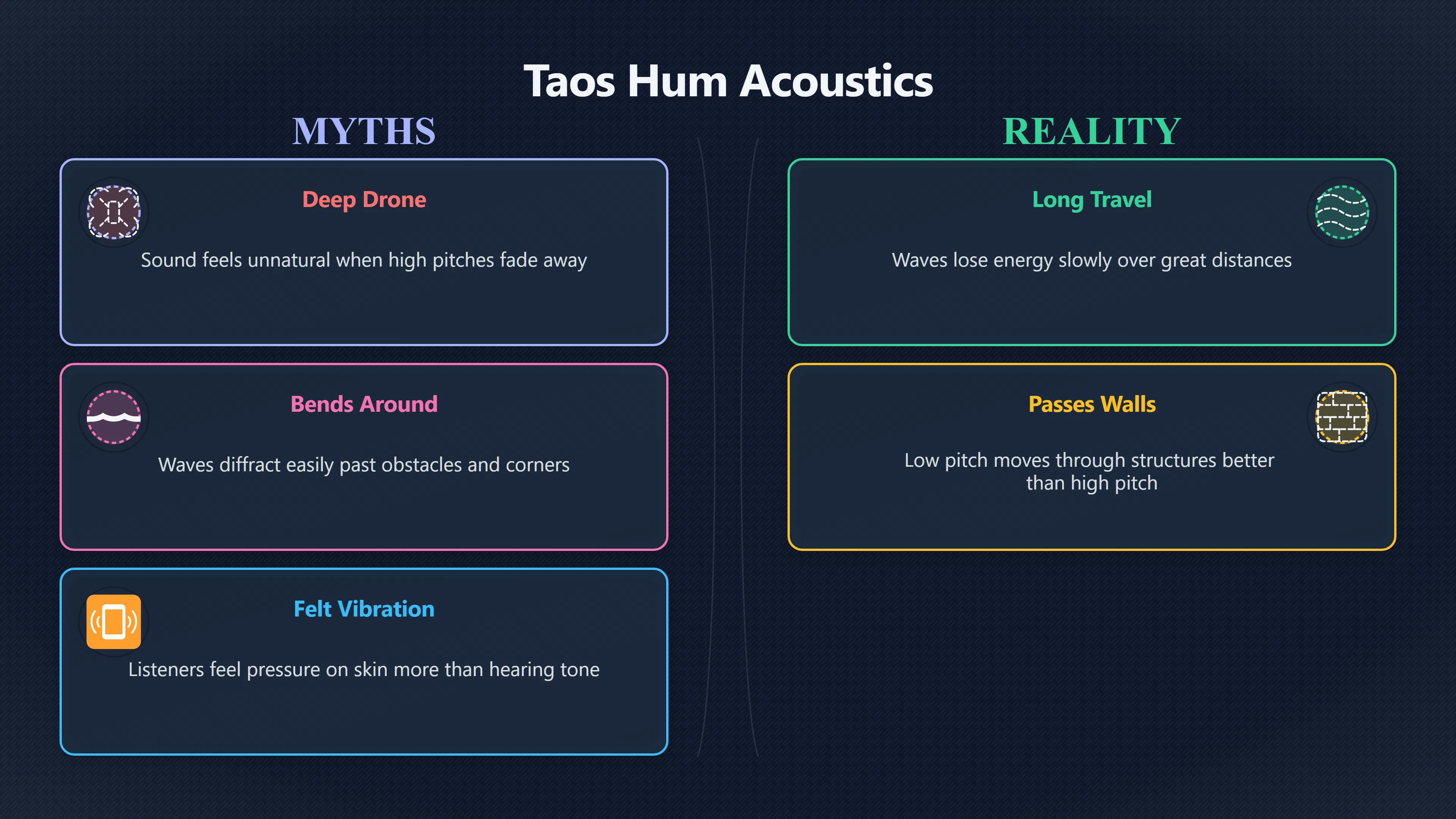
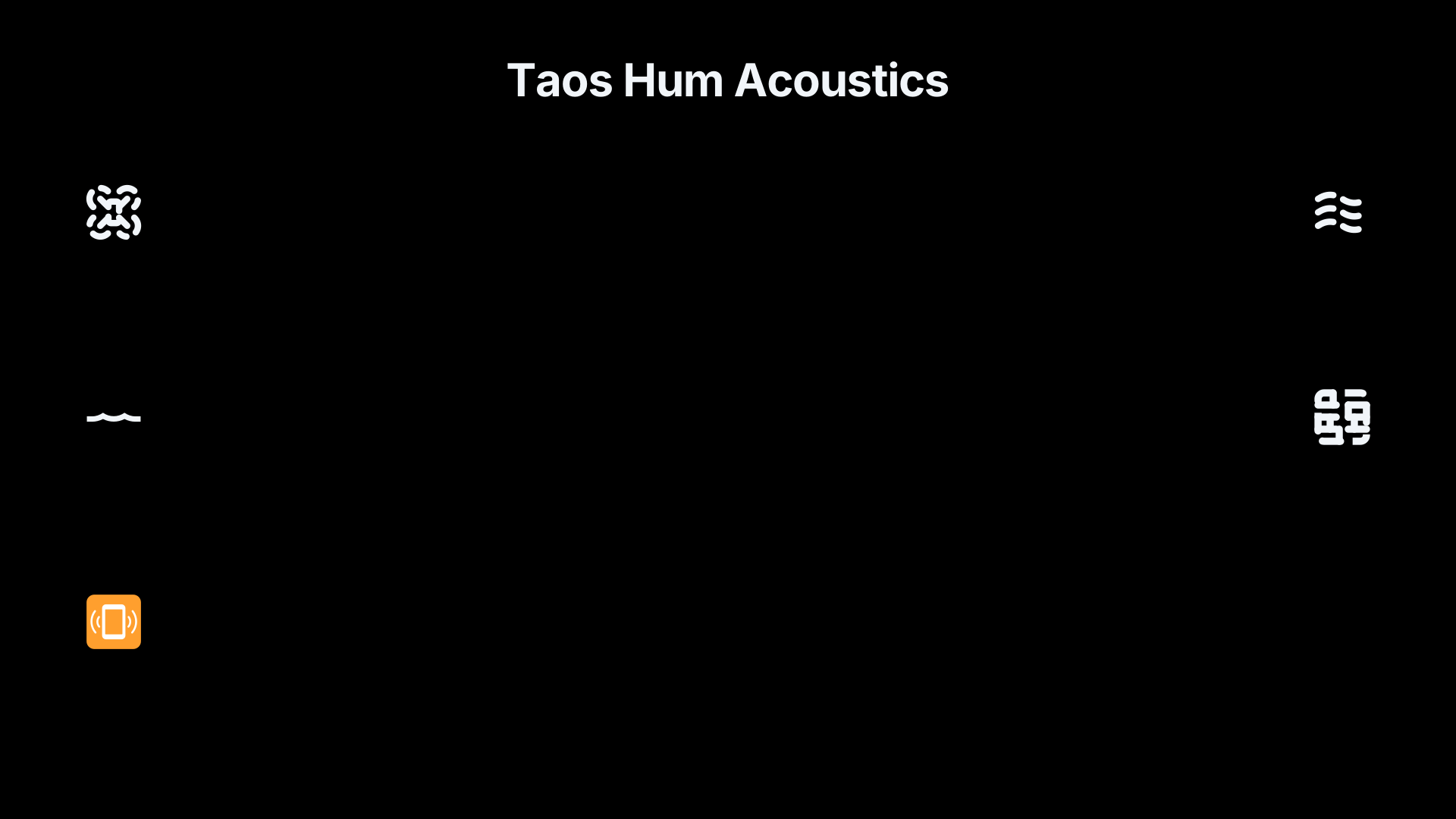
Low-frequency sound has several properties that make it unusually difficult to investigate:
- It loses energy more slowly over distance than many higher-frequency sounds.
- It bends around obstacles more easily, a process known as diffraction.
- It can pass through walls and structures more effectively than higher-pitched noise.
- It may be felt as vibration or pressure as much as heard as sound.[physicslab.org]physicslab.orgIntroduction to SoundIn general, low frequency waves travel further than high frequency waves because there is less energy transferred to…[2Commercial Acoustics®]commercial-acoustics.comHigh frequencies are more directional and less prone to bending.Read moreCommercial Acoustics®How Sound Travels: The Science of Sound Waves!Dec 11, 2020 — Low-frequency waves diffract more easily, making them m…
A useful comparison is distant thunder. When a storm is far away, the sharp crack disappears first, while the deep rumble remains. The atmosphere naturally filters out much of the higher-frequency content, leaving lower frequencies to dominate what reaches the listener.[madsci.org]madsci.orgWhy do low frequency waves seem to travel farther than…Nov 19, 1999 — Next time you hear thunder notice that the farther away the ligh…
This matters because a conventional source can begin to sound strange when only its bass components survive the journey. A pump, ventilation system, compressor, industrial motor or traffic corridor may no longer resemble its original sound after travelling several kilometres. What reaches the listener can be an abstract drone with no obvious identity.[Commercial Acoustics®]commercial-acoustics.comHigh frequencies are more directional and less prone to bending.Read moreCommercial Acoustics®How Sound Travels: The Science of Sound Waves!Dec 11, 2020 — Low-frequency waves diffract more easily, making them m…
Why Direction Finding Becomes Unreliable
Humans are surprisingly poor at locating very low sounds.
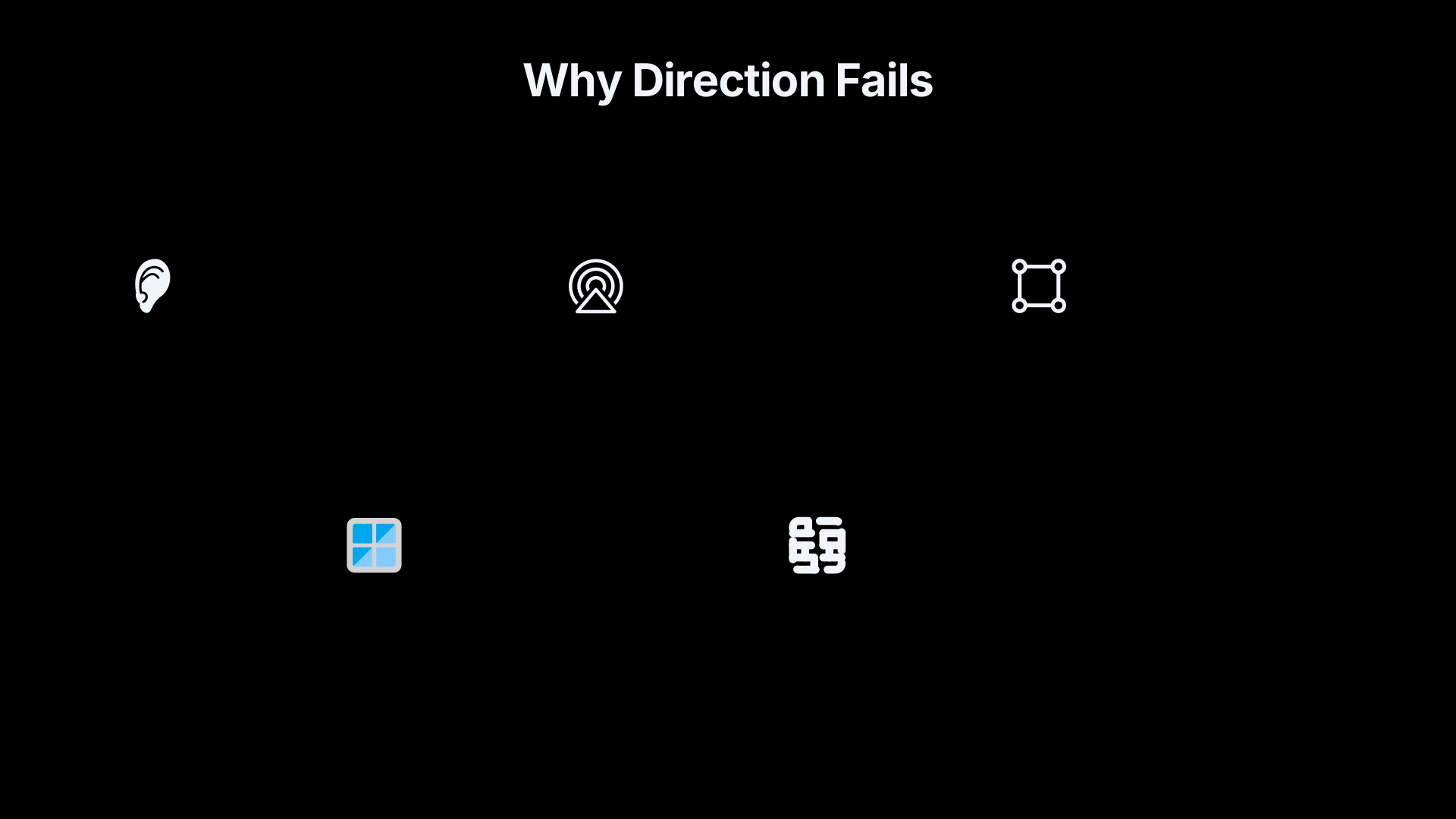
Normally, the brain determines direction by comparing tiny differences in arrival time and intensity between the left and right ears. With higher-frequency sounds, these differences are easier to detect. With long-wavelength low-frequency sound, those directional cues become weaker and less precise. The result is that listeners often know a sound exists without knowing where it originates.[Commercial Acoustics®]commercial-acoustics.comHigh frequencies are more directional and less prone to bending.Read moreCommercial Acoustics®How Sound Travels: The Science of Sound Waves!Dec 11, 2020 — Low-frequency waves diffract more easily, making them m…
For someone experiencing the Taos Hum, this can create a particularly unsettling effect. A sound may seem:
- Behind the listener one moment and ahead the next.
- Present throughout an entire room rather than from a single point.
- Stronger indoors than outdoors.
- Impossible to follow to a source.[The International Tinnitus Journal]tinnitusjournal.comThe International Tinnitus JournalManifestations of a low-frequency sound of unknown origin…by FG Frosch · 2016 · Cited by 8 — The Hum…
Buildings can make the problem worse. Low-frequency waves can excite vibrations in walls, floors and windows. Instead of hearing the original source directly, a person may hear or feel secondary vibrations generated by the building itself. The apparent source then shifts from the real origin to whichever surface happens to be resonating most strongly.[Commercial Acoustics®]commercial-acoustics.comHigh frequencies are more directional and less prone to bending.Read moreCommercial Acoustics®How Sound Travels: The Science of Sound Waves!Dec 11, 2020 — Low-frequency waves diffract more easily, making them m…
This helps explain why some Hum witnesses have reported that the sound seemed to move, disappear when they changed position, or become more noticeable in particular rooms. Such behaviour can arise from acoustic interactions rather than from a moving object.[westminsterresearch.westminster.ac.uk]westminsterresearch.westminster.ac.ukSuch sensitivity may be a result of heightened sensory.Read more…
Why Some People Hear It and Others Do Not
The Taos investigations found another clue that complicated the search: only a small fraction of residents reported hearing the Hum at all. Even among hearers, descriptions varied.[Acoustical Society of America]acousticalsociety.orgAcoustical Society of Americav5n3 echoes:Layout 116 Apr 2017 — First, the hum is selective. Only a small percentage of Taos residents per…
Low-frequency perception differs significantly between individuals. Small differences in hearing sensitivity can determine whether a person notices a sound near the threshold of audibility. Age, background noise exposure, hearing characteristics and even the acoustics of a particular room can affect perception.[Sage Journals]journals.sagepub.comSage JournalsLow frequency and infrasound: A critical review of the…by JH Mühlhans · 2017 · Cited by 26 — The aim of this review is to…
Researchers studying Hum phenomena have also explored whether some reports may involve internal auditory mechanisms rather than external sound alone. Proposed explanations have included unusual sensitivity to certain frequencies and, in some cases, rare forms of low-frequency tinnitus-like perception. These ideas remain debated, but they illustrate why a single environmental measurement may not fully match every listener’s experience.[Los Angeles Times]latimes.comla xpm 1993 09 01 mn 30113 storyLos Angeles TimesIn Taos, Researchers Can Hum It, but They Can't Name…1 Sept 1993 — Such low-frequency oto-acoustic emissions occur wh…
The result is a confusing investigative picture. A sound may be real for one listener, absent for another, and difficult for instruments to capture if the signal is weak, intermittent or near the limits of ordinary recording equipment.[ICBEN]icben.ethz.chonitor low frequency acoustic signals and that microphone picked up nothing unusual in that study.Read more…
Why Instruments Often Struggle With the Same Sounds
A common assumption is that if investigators cannot record a sound, the sound must not exist. Low-frequency acoustics are more complicated than that.
Many microphones and consumer recording devices are optimised for ordinary speech and everyday environmental sounds. Extremely low-frequency signals can fall near or below the range where such equipment performs reliably. Investigators of Hum reports have repeatedly noted the need for specialised monitoring systems.[ICBEN]icben.ethz.chonitor low frequency acoustic signals and that microphone picked up nothing unusual in that study.Read more…
The original Taos investigation used acoustic, seismic and electromagnetic monitoring in an attempt to correlate reports with measurable signals. Despite extensive effort, researchers did not identify a single external source that matched all reported experiences. Importantly, this was not the same as proving that no low-frequency source existed. It demonstrated how difficult it can be to isolate a weak, geographically variable signal in a complex environment.[IFLScience]iflscience.comScientists found nothing, so what was it? Rachael Funnell headshot.Read more…[ICBEN]icben.ethz.chonitor low frequency acoustic signals and that microphone picked up nothing unusual in that study.Read more… That distinction often gets lost in UFO discussions. Failure to identify a source is sometimes interpreted as evidence for an extraordinary source, when it may instead reflect the well-known challenges of measuring and tracing low-frequency noise.[Sage Journals]journals.sagepub.comSage JournalsLow frequency and infrasound: A critical review of the…by JH Mühlhans · 2017 · Cited by 26 — The aim of this review is to…
What This Means for Invisible UFO-Noise Claims
The Taos Hum occupies an unusual position in UFO culture because it provides many of the psychological ingredients that make extraordinary explanations attractive.
People reported a persistent sound with no visible source. The sound seemed difficult to locate. Some individuals heard it while others did not. Investigators could not immediately identify a cause. These are the same conditions that often surround rumours of hidden craft, underground bases or secret propulsion systems.[Wikipedia]WikipediaThe HumThe Hum is a persistent and invasive low-frequency humming, rumbling, or droning noise audible to many, but not all, people in an…
Yet the acoustic clues point in a different direction. Every major feature of the Hum that appears mysterious from a human perspective — poor localisation, selective audibility, vibration-like sensation and long-range propagation — is also characteristic of low-frequency sound itself.[Commercial Acoustics®]commercial-acoustics.comHigh frequencies are more directional and less prone to bending.Read moreCommercial Acoustics®How Sound Travels: The Science of Sound Waves!Dec 11, 2020 — Low-frequency waves diffract more easily, making them m…[Sage Journals]journals.sagepub.comSage JournalsLow frequency and infrasound: A critical review of the…by JH Mühlhans · 2017 · Cited by 26 — The aim of this review is to…
That does not solve the Taos mystery. The exact source or sources behind reported experiences remain disputed. What it does show is that the most important evidence in the case is not necessarily the absence of an explanation. It is the presence of a specific type of sound behaviour that naturally creates the impression of an invisible, difficult-to-trace origin. In the context of UFO-noise claims, that makes low-frequency acoustics less a clue pointing toward extraordinary technology and more a clue explaining why ordinary sound sources can sometimes feel extraordinary.[ICBEN]icben.ethz.chonitor low frequency acoustic signals and that microphone picked up nothing unusual in that study.Read more…

Amazon book picks
Further Reading
Books and field guides related to Why Low Sounds Are So Hard to Trace. Use these as the next step if you want deeper reading beyond the article.
The Science of Sound
Covers frequency behavior, resonance and environmental acoustics.
Introduction to Sound
Explains sound propagation and why low-frequency noises are difficult to locate.
The Demon-Haunted World
Rating: 4.5/5 from 43 Google Books ratings
Useful framework for evaluating unusual sound claims.
Mysteries of the Unexplained
Provides wider context for mysterious environmental phenomena.
eBay marketplace picks
Marketplace Samples
Example marketplace items related to this page. Use the search link to explore similar finds on eBay.




Endnotes
1.
Source: thrillist.com
Title: taos hum mystery
Link:https://www.thrillist.com/travel/nation/taos-hum-mystery
Source snippet
Investigating the Mystery of the Taos Hum29 Jun 2023 — The low buzz ranging from 30 to 80 Hz that had been reportedly heard by a...
2.
Source: iflscience.com
Link:https://www.iflscience.com/the-taos-hum-had-residents-in-new-mexico-convinced-they-could-hear-something-69672
Source snippet
Scientists found nothing, so what was it? Rachael Funnell headshot.Read more...
3.
Source: Wikipedia
Link:https://en.wikipedia.org/wiki/The_Hum
4.
Source: commercial-acoustics.com
Title: High frequencies are more directional and less prone to bending.Read more
Link:https://commercial-acoustics.com/sound-advice/how-sound-travels/
Source snippet
Commercial Acoustics®How Sound Travels: The Science of Sound Waves!Dec 11, 2020 — Low-frequency waves diffract more easily, making them m...
5.
Source: discoveryuk.com
Title: Discovery UKThe Taos Hum: New Mexico’s Unexplained Acoustic
Link:https://www.discoveryuk.com/mysteries/the-taos-hum-new-mexicos-unexplained-acoustic-phenomenon/
Source snippet
December 14, 2023 — 14 Dec 2023 — Lower frequencies below 20 Hz can sometimes be felt as vibrations rather than heard as sound, and while...
Published: December 14, 2023
6.
Source: physicslab.org
Link:https://www.physicslab.org/Document.aspx?doctype=3&filename=WavesSound_IntroSound.xml
Source snippet
Introduction to SoundIn general, low frequency waves travel further than high frequency waves because there is less energy transferred to...
7.
Source: madsci.org
Link:https://www.madsci.org/posts/archives/nov99/943317470.Ph.r.html
Source snippet
Why do low frequency waves seem to travel farther than...Nov 19, 1999 — Next time you hear thunder notice that the farther away the ligh...
8.
Source: westminsterresearch.westminster.ac.uk
Link:https://westminsterresearch.westminster.ac.uk/download/48d989044c72806ed0ad4e0907c3ca7accb01311215117b6226d46abcf0a949c/921008/Benton_2003.pdf
Source snippet
Such sensitivity may be a result of heightened sensory.Read more...
9.
Source: icben.ethz.ch
Link:https://icben.ethz.ch/2008/PDFs/Cowan.pdf
Source snippet
onitor low frequency acoustic signals and that microphone picked up nothing unusual in that study.Read more...
10.
Source: journals.sagepub.com
Link:https://journals.sagepub.com/doi/abs/10.1177/1029864917690931
Source snippet
Sage JournalsLow frequency and infrasound: A critical review of the...by JH Mühlhans · 2017 · Cited by 26 — The aim of this review is to...
11.
Source: tinnitusjournal.com
Link:https://www.tinnitusjournal.com/articles/manifestations-of-a-lowfrequency-sound-of-unknown-origin-perceived-worldwide-also-known-as-the-hum-or-the-taos-hum.html
Source snippet
The International Tinnitus JournalManifestations of a low-frequency sound of unknown origin...by FG Frosch · 2016 · Cited by 8 — The Hum...
12.
Source: acousticalsociety.org
Link:https://acousticalsociety.org/wp-content/uploads/2018/02/v5n3.pdf
Source snippet
Acoustical Society of Americav5n3 echoes:Layout 116 Apr 2017 — First, the hum is selective. Only a small percentage of Taos residents per...
13.
Source: latimes.com
Title: la xpm 1993 09 01 mn 30113 story
Link:https://www.latimes.com/archives/la-xpm-1993-09-01-mn-30113-story.html
Source snippet
Los Angeles TimesIn Taos, Researchers Can Hum It, but They Can't Name...1 Sept 1993 — Such low-frequency oto-acoustic emissions occur wh...
14.
Source: science.howstuffworks.com
Title: the hum
Link:https://science.howstuffworks.com/science-vs-myth/unexplained-phenomena/the-hum.htm
Source snippet
Works30 Nov 2023 — Hum sufferers describe a low-frequency buzz accompanied by a rumbling vibration. It's worse at night, making it almost...
Additional References
15.
Source: pressbooks.pub
Link:https://pressbooks.pub/sound/chapter/how-sound-moves/
Source snippet
How sound moves – Understanding SoundFrequency of the sound does not matter- high frequency sounds travel at the same speed as low freque...
16.
Source: khanacademy.org
Link:https://www.khanacademy.org/science/ms-physics/x1baed5db7c1bb50b%3Awaves/x1baed5db7c1bb50b%3Asound-waves/v/sound-waves
Source snippet
Sound waves (video) | WavesThe frequency of a sound wave corresponds to its pitch. The speed of a sound wave depends on the medium its tr...
17.
Source: victoriagunn.com
Link:https://victoriagunn.com/blog/wonders-of-taos-the-taos-hum
Source snippet
Taos Hum Mystery in Taos, NM | Wonders of TaosThe Taos Hum is a mysterious low-frequency sound reported by a significant number of locals...
18.
Source: timesofindia.indiatimes.com
Link:https://timesofindia.indiatimes.com/science/what-is-the-mysterious-[humming
Source snippet
Since the early 1990s, some residents of Taos, New Mexico, have reported hearing a persistent low-frequency noise known as the "Taos Hum...
19.
Source: reddit.com
Link:https://www.reddit.com/r/UnresolvedMysteries/comments/89ndpp/unresolved_mystery_taos_hum/
Source snippet
[Unresolved Mystery] Taos Hum: r/UnresolvedMysteriesThe Hum is a phenomenon involving widespread reports of a persisent low frequency hu...
20.
Source: physics.stackexchange.com
Link:https://physics.stackexchange.com/questions/87751/do-low-frequency-sounds-really-carry-longer-distances
Source snippet
low frequency sounds really carry longer distances?Nov 24, 2013 — It is a common belief that low frequencies travel longer distances...
21.
Source: researchgate.net
Link:https://www.researchgate.net/publication/273078532_Low_Frequency_Noise_and_Phantom_Sounds
Source snippet
Acoustics Today, a publication of The Acoustic Society of America. It has a...Read more...
22.
Source: biorxiv.org
Link:https://www.biorxiv.org/content/10.1101/2025.06.07.658448v2.full.pdf
Source snippet
On the potential sources of a low-frequency sound percept...by B Baumann · 2025 — Manifestations of a low-frequency sound of unknown ori...
23.
Source: facebook.com
Link:https://www.facebook.com/WIONews/posts/ever-heard-a-mysterious-deep-humming-sound-that-others-around-you-couldnt-hear-t/1337937641778740/
Source snippet
d as a constant, droning noise—like the hum of a distant...Read more...
24.
Source: pubmed.ncbi.nlm.nih.gov
Link:https://pubmed.ncbi.nlm.nih.gov/27488996/
Source snippet
of a low-frequency sound of unknown origin...by FG Frosch · 2016 · Cited by 8 — Hum-oscillations are typically influenced by head rotati...
Topic Tree